
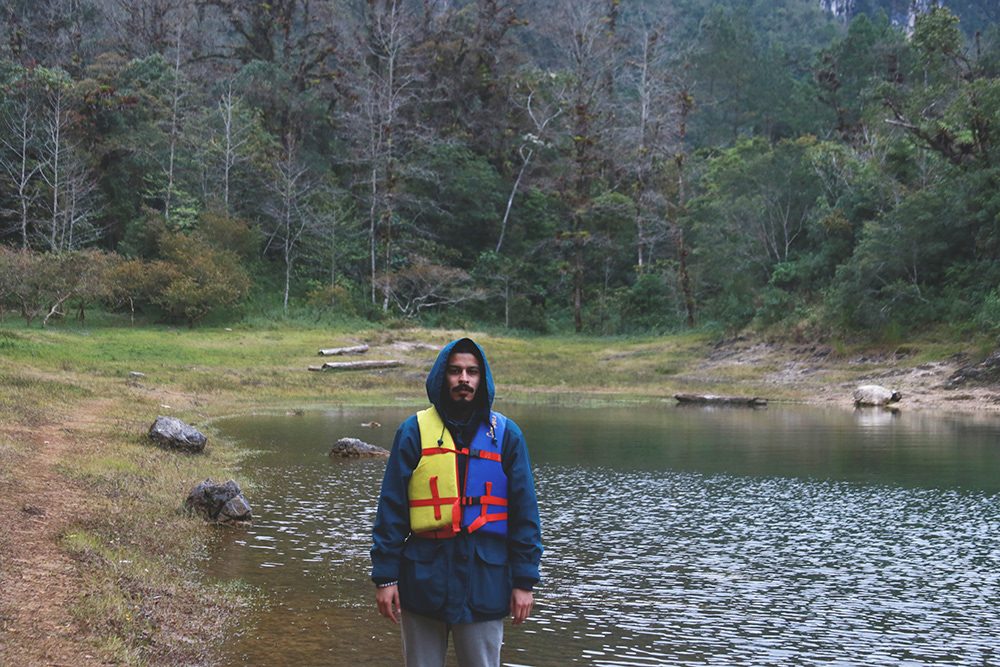
Josemar Gonzalez Lizarraga
Josemar Gonzalez is a multidisciplinary artist whose work examines the systems that condition us. He moves across film, photography, installation, design, and music, and has arrived at a persistent line of inquiry: how technologies of observation settle into ordinary life, and what it takes for a community to look back at them.
Data Breach is his most direct engagement with that question. Structured as a countersurveillance fellowship, the project trains participants to identify and investigate the surveillance systems operating in their own neighborhoods, then brings those findings into public view. Developed with The AjA Project, the fellowship culminated in a 2026 exhibition in City Heights. The neighborhood sits in the San Diego-Tijuana border region, inside the hundred-mile band where federal enforcement claims expanded authority, and the surveillance infrastructure that follows settles into blocks where many residents are immigrants and refugees. Gonzalez designed the project's identity and moved it as a campaign, using the apparatus of branding and public persuasion on the systems that depend on it. The work poses a question that circulates through Gonzalez's recent projects and collaborations: who watches who.
His films approach the same territory sideways. He shoots his own film photography and treats moving image as its extension. A Cambio de Qué? (2025), which he directed and performs in, is an absurdist account of failing technology and money that vanishes, its science fiction register letting him test the logic of a system by pushing it past sense. He acts in his own films and in other directors' work, appearing as a lead in Apocatastasis (2022, Shinpei Takeda), where he wrote much of his own dialogue, and in Like Honey (2023, Nicole Valencia). Films he has made and contributed to have screened internationally, including in Japan and Germany. Transcending Perception, his installation at Liberty Station in San Diego, carries the same attention to perception and the instruments that shape it. He has exhibited in the United States and Mexico.
What holds these together is a framework Gonzalez has built over fifteen years inside community-based arts organizations. He designs structures other people can work inside: an archive that keeps collecting, a curriculum that trains investigators, an exhibition that publishes what they find. BorderClick, the digital living archive he founded in 2016, is built on education and self-documentation. Students living transborder lives photograph their own conditions, and the archive holds what they make, accumulating beyond any single contributor. The California Assembly and California Humanities recognized the project in 2018, and the California Arts Council named Gonzalez an Established Artist Fellow in 2021-2022. That principle carries into his documentation work with justice-impacted communities and into the fellowship structure of Data Breach.